
Learn With Jermaine—Subscribe Now!
I share what I learn each day about entrepreneurship—from a biography or my own experience. Always a 2-min read or less.
Trump Accounts Just Got $6.25 Billion More Interesting
Earlier this week, I posted about Trump accounts potentially reshaping the stock market (see here). I used Michael Dell’s $6.25 billion donation to Trump accounts as an example of how direct stock ownership could be passed to tens of millions of Americans. However, it now appears that Dell is taking a different approach.
Yesterday (10/8/26), Dell announced that on Friday, 10/9/26, 25 million children will have $250 deposited into their Trump accounts in fulfillment of his donation promise. See his post on X announcing it here and below:
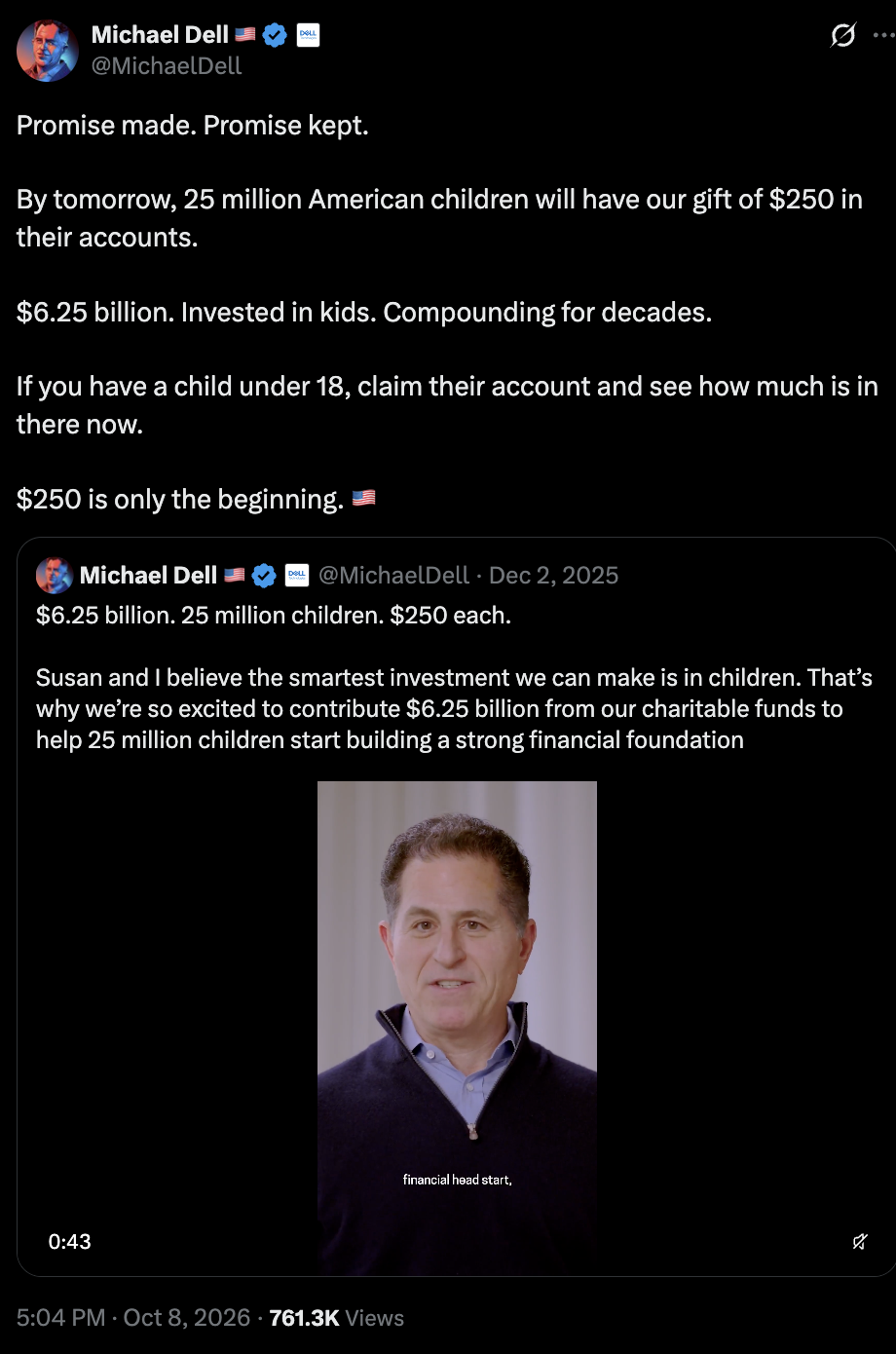
It looks like this is a cash contribution to the accounts, not a stock contribution.
The rollout of Trump accounts is moving fast. This $6.25 billion donation is evidence of that, and I imagine others will donate to Trump accounts. We’ve never seen anything like this before. I’m curious about how this rollout will go and what the long-term impacts on the stock market will be.
The Missing Link Between My Two Reading Habits
A new habit of mine this year is being intentional about rereading books. I try to reread at least one book a month, so my objective is three new books a month and one reread. That’s working pretty well, and I’m happy with it.
What I’m not happy with is my inconsistency around synthesizing books (see this example). I’ve tried a few times to get consistent, but I haven’t cracked it yet. My big takeaway is that synthesizing every book I read won’t work. I don’t have enough time and bandwidth, and also I’ve realized that not all books are worth synthesizing. Some books are good, and some are great. I want to synthesize only the great ones. Partly this is a way of making sure important concepts stick, and partly it’s a way to make it possible to read through the most important concepts in a fraction of the time.
Thinking about the book I’m rereading this week, I decided it’s a great one and I’d like to use this week to not only reread it but also synthesize it. The more I thought about it, the more I realized that might be the missing habit that will make me synthesize the best books I read more consistently.
So, this week I’m experimenting with this. Hopefully it works out and I can kill two birds with one stone by rereading and synthesizing the same book this week.
Revenue Isn’t Enough to Match Entrepreneurs
I’m creating the next set of accountability peer groups for entrepreneurs and have spoken with several strong entrepreneurs. I’m using revenue as a proxy for product–market fit. Basically, if you have over $1M in revenue, you likely have product–market fit. It’s not perfect, but it’s a simple and easy filter everyone can understand.
I’m seeing a difference within the group of entrepreneurs who have product–market fit. Two companies can each have $2M in revenue but be at different stages. For example, one might have had $1M in revenue last year; the other, $2.25M. They will be dealing with different challenges. And they might have different objectives. One may be focused on rapid growth and the other on maintenance and profit harvesting.
Given this difference, I’m now thinking that my initial conversations with entrepreneurs should include understanding their revenue for the last few years so I can determine their growth rate. I can then ask questions about how they feel about that growth rate and what help they want from their peers (if any) in changing it.
I’ll think about this more and discuss it with others, but understanding historical growth rate might help as a filter and in matching like-minded entrepreneurs.
Could Trump Accounts Reshape the Stock Market?
Last week, the Treasury Department announced that it will automatically enroll more than 60 million children under 18 in the government’s Trump accounts. The speed with which it is acting on this initiative speaks volumes about its priority. The government announced the accounts in June. The idea behind them is for children to build wealth by being invested in the U.S. stock market at an early age. Any child born between 2025 and 2028, inclusive, will receive a contribution of $1,000 from the government if the child’s parent or guardian elects this option while setting up the account. Accounts have a $5,000 annual contribution limit, and contributions can be made via payroll deductions (i.e., Mom and Dad can have it come out of their paycheck).
The law says the fund’s administrators must invest cash contributed to these accounts in index funds, but that doesn’t apply to stock donations: It will be legal for someone to donate an individual stock to a minor via their Trump account (the minor or their parents just can’t sell the stock for five years).
Michael Dell committed to donating over $6 billion to Trump accounts a few months back. In theory, he could gift $6 billion in Dell stock to Trump accounts, and that would be within the rules. Said differently, Dell (or any other wealthy person, for that matter) could instantly make millions (or tens of millions) of children shareholders in a single company.
I don’t think anything like this has ever existed before, and Trump accounts seem like a big deal. As far as I know, this is the first time that the ability to give ownership in a single public company (free of charge) to a large percentage of the population, and restrict their ability to sell, has existed.
I need to noodle on this more, but based on my reading about the history of the stock market and ETFs, this feels like something that could transform the U.S. stock market.
Weekly Update: Week 340
Current Project: Reading books about entrepreneurs and investors and sharing what I learned from them
Mission: Create a library of wisdom from notable entrepreneurs that current entrepreneurs can leverage to increase their chances of success
Cumulative metrics (since 4/1/24):
- Total books read: 135
- Total blog posts published: 1,000
This week’s metrics:
- Books read: 1
- Blog posts published: 7
What I completed in the week ending 10/4/26 (link to the previous week’s commitments):
- Read The King of Oil by Daniel Ammann, a biography about commodity entrepreneur and fugitive Marc Rich. Rich created today’s spot market for oil, and for decades his firm was the main conduit through which many nations bought and sold oil. Interesting backstory on Iran and Israel’s relationship.
What I’ll do next week:
- Read a biography, autobiography, or framework book
Week three hundred forty was another week of learning. Looking forward to next week!
What I Learned Last Week (10/4/26)
Below, I share content I consumed and learned from last week. I spent time doing general learning about a variety of topics.
What I consumed last week and what I learned from it:
- Building a $90M YouTube channel – YouTube interview with Ashkan Karbasfrooshan, entrepreneur and founder of WatchMojo, which has a popular YouTube channel. This is a great interview that highlights how YouTube and other platforms are empowering niche media entrepreneurs to create fortunes. His logic around how he decided to bet on YouTube when he started his company was interesting. He thought like a social scientist and challenged himself to figure out what the next MTV would look like. His epiphany was that geek culture was going to take over pop culture, and he leaned into that belief as a content strategy.
That’s what I learned from what I consumed last week.
More Ad Shots on Goal = 10x Growth
This week, I met an early-stage software entrepreneur who’s grown his revenue from $400k last year to about $2.5m and intends to close the year at about $4m. That’s about 6x so far this year and around 10x at year’s end. What’s the secret to this hyper growth?
The most important thing is a great software product. They’ve iterated over the last two years and finally found something that resonates with customers. The big unlock was social media marketing. They’ve been using a strategy that involves paying an army of smaller creators for content, then repurposing it as paid ads across social media platforms.
The idea is to get as many shots on goal as possible so you can find the handful of videos that have viral potential. Once you find those home-run videos, you run them as ads with a ton of money behind them. Of course, you have to run the numbers to know your customer acquisition cost, payback period, etc.
I really like this strategy, and I think it’s worth studying for entrepreneurs who are selling products or goods to individual consumers online.
Does Everything Deserve Your Best?
This week, I listened to two founders debate a well-known quote:
How you do one thing is how you do everything.
~Unknown
One founder thought the saying holds true and means you should do everything to the best of your ability, regardless of how big or small the task is. The other founder thinks you should be selective. He believes you have limited bandwidth, and you should allocate it accordingly based on the importance of the task. Some things don’t require perfection. Done is better than perfect for things that don’t require perfection. But for items of high importance, a high level of execution is required.
Two interesting perspectives.
He Has $1 Million. He’s Shutting Down Anyway.
A few years ago, I shared the power of sending update emails with the founder of an AI start-up. Shortly after that, he began sending updates to investors and supporters. I was included on the list, and even though we haven’t chatted in over a year, I’ve been following his progress closely.
This week, he sent an update notifying everyone that he’s shutting down his start-up. His reason is that the market he’s in is too competitive and consolidation has begun. Everyone is building essentially the same AI product, so I’m assuming margins were either not great or nonexistent.
This founder raised seven figures of venture capital. Interestingly, he’s shutting the company down with tons of cash in the bank. He has $1.1 million in cash, but instead of burning through it in a hyper-competitive market, he’s returning it to investors. He plans to work on something more promising.
I’m sure there’s more to this story, and I’ll reach out to the founder. My gut tells me that he’s optimizing for the best and highest use of his time in his prime years and concluded that his start-up isn’t the best use of his time anymore.
I Don’t Understand Oil
Over the last few months, the price of oil (and energy generally) has made headlines. I don’t know much about oil, its history, or how it has historically impacted politics. Lately, though, founders and everyday people have been telling me how fuel prices are impacting them. Just this week, one founder shared how the margins of his business are down because diesel prices are so high.
I want to understand the current oil situation better, so this week I started reading a biography of an entrepreneur who supposedly built a massive company that created the current oil trading markets.
I’m curious about this topic, and I hope this entrepreneur’s story helps me understand it. I’m looking forward to finishing the book and adding it to this site’s library this weekend.