How to Avoid Mistakes When Problems Are Complex and High Risk
As part of my Thanksgiving challenge (see here), I said I’d synthesize three reads. This is the third synthesis.
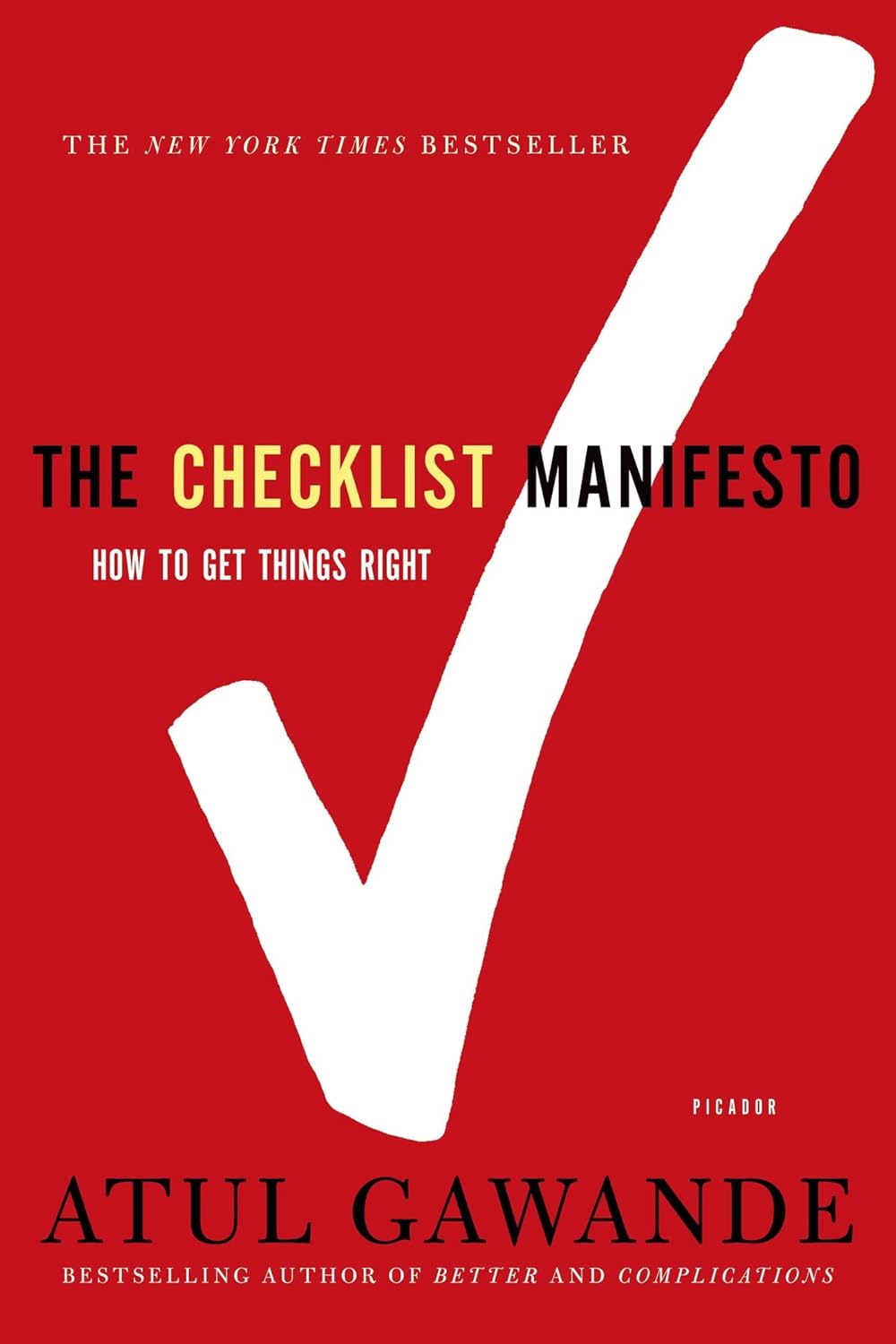
Earlier this year and last year, I read several books by people who’d achieved outsize success. All of them talked about the importance of checklists. I was curious to understand why checklists were so helpful, so I read The Checklist Manifesto by Atul Gawande. Here’s what I learned:
Main idea: Checklists increase your chances of success in situations with extreme complexity. Catching errors early and forcing consistent execution, they reinforce discipline.
Extreme complexity is a significant problem. As a society, we’ve created more know-how about difficult situations and problems than has ever before existed. We’ve armed the most intelligent people with all this know-how, but it’s unmanageable. There’s too much of it, and it’s exceedingly complex. No one can consistently apply it correctly, safely, and reliably.
In certain fields—medicine, for example—managing extreme complexity has become an art form. Most people struggle with doing it consistently. In a life-or-death field like medicine, the result can be tragedy.
I find it helpful to think about any failure as falling into one of these three categories:
- Necessary fallibility – Some things are beyond your capacity to understand or do, but you try anyway.
- Ignorance – You don’t have a full understanding of how something works. A doctor isn’t aware of the latest studies on treatment of a particular condition and gives a patient the wrong treatment plan for his illness.
- Ineptitude – You have a full understanding of the relevant knowledge, but you failed to apply it correctly. A five-story building that you designed collapsed due to a flaw.
Why is the main idea important?
Professions in which risk, reward, complexity, and uncertainty are high benefit most from checklists. The discipline involved in following processes and procedures improves decision-making and consistency of action and increases the chances of positive outcomes.
Increasing your chances of success in fields with power-law distributions, such as entrepreneurship or investing, means that checklists can pay significant dividends.
Before I get into the requirements for a checklist, it’s helpful to understand that there are two types of checklists:
- DO–CONFIRM – A job was performed from memory and experience. Then you run through a checklist and confirm that everything required was done.
- READ–DO – People carry out tasks as they check them off on a checklist. It’s more like following a recipe. High-pressure, time-sensitive situations benefit from READ-DO checklists. Think of an airplane with a mechanical issue mid-flight.
So, what makes a good checklist? Most of us have seen good checklists, but here are a few things to keep in mind:
- Have a clear and concise objective for the checklist.
- Focus on “killer items,” critical steps that are dangerous to overlook but sometimes skipped.
- Make them actionable, with a specific response for each item.
- Include five to nine items, which is the limit of working memory. There’s flexibility in this, though.
- Checklists aren’t comprehensive how-to guides. They’re quick, simple tools to help people navigate tough situations using skills they already have.
- Use simple, easy-to-understanding wording.
- Always test the checklist in the real world before finalizing it, because the real world is always more complex than expected.
- Bad checklists are “vague, imprecise, too long, hard to use, and impractical.” They’re often created by people who aren’t doing the work themselves or aren’t familiar with its details.
- Good checklists are “precise, straight to the point, and easy to use in difficult situations.” Provide reminders of only the most important steps, not every single step. They’re practical and created by people who understand the work being done.
That’s it; that’s what I learned from reading this book. My big takeaway is that checklists are simple and effective tools with an outsize impact in critical situations. There’s nothing terribly complicated about creating them. The hardest part is having the discipline to use them consistently.
2009
Framework
by
Atul Gawande
2009