This Week's Book: How the Pritzkers and Other Chicago Families Built Enduring Business Empires
In several books, I’ve read about a particular family and their above-average deal-making skills. The Pritzkers are a Chicago-based family known for turning Hyatt hotels and numerous ventures into a sprawling, wildly successful empire of closely held private companies. According to a 2013 WSJ article (see here), the family empire of over 150 companies was worth $30 billion in 2011. Curious, I started researching them, but I couldn’t find much. I did find one book, a biographical anthology—not quite what I was looking for, but it was all I had.
The Fortune Builders, written in 1986, profiles the wealthiest Chicago families who built companies that had significant impacts on America. Most chapters are dedicated to telling a single family’s multigenerational story, beginning with these patriarchs:
- Cyrus Hall McCormick: McCormick Harvesting Machine Company/Navistar
- Philip D. Armour: Armour & Company
- Marshall Field: Marshall Field & Company
- The Pritzker family (including Jay Pritzker): Hyatt Hotels
- John D. MacArthur: Bankers Life and Casualty
- William Wrigley Jr.: Wrigley Company
- Arthur C. Nielsen Sr.: A.C. Nielsen Company
- Gustavus Franklin Swift: Swift & Company
The Pritzker family profile was exactly what I was looking for. It went deep into the family’s origins. Interestingly, they were all lawyers as of the book’s publication date and the law firm they started decades earlier stopped taking outside clients to do legal work only for the family and its companies. The book tells the story of how the family acquired the original Hyatt hotel and grew it into a leading international hotel brand. It also talks about the family’s vast portfolio of companies.
The other profiles that stood out were those of Marshall Field, the department store magnate, and Cyrus McCormick. Marshall built an enormous business (it was doing roughly $35 million in revenue in 1895 or $1.35 billion in 2025 dollars). Subsequent generations turned it into a diversified empire with stakes in real estate, newspapers, magazines, radio stations, TV stations, and various other industries.
Cyrus McCormick was a controversial figure who took his father’s concept for a wheat reaper and turned it into the McCormick Harvesting Machine Company, which changed farming and global food production. That company then became International Harvester, one of the largest tractor manufacturers, and later became Navistar International Corp, a major global manufacturer of commercial and heavy-duty trucks. So, any school bus, dump truck, or 18-wheeler with an “International” logo is the result of the McCormick family’s efforts across a century.
I had no idea about the origins of these families and the impact they had on American society. I’m glad I read this book. I’ll definitely look for more to read on several of these families.
Anyone interested in how entrepreneurs shaped Chicago and the nation should consider reading The Fortune Builders.
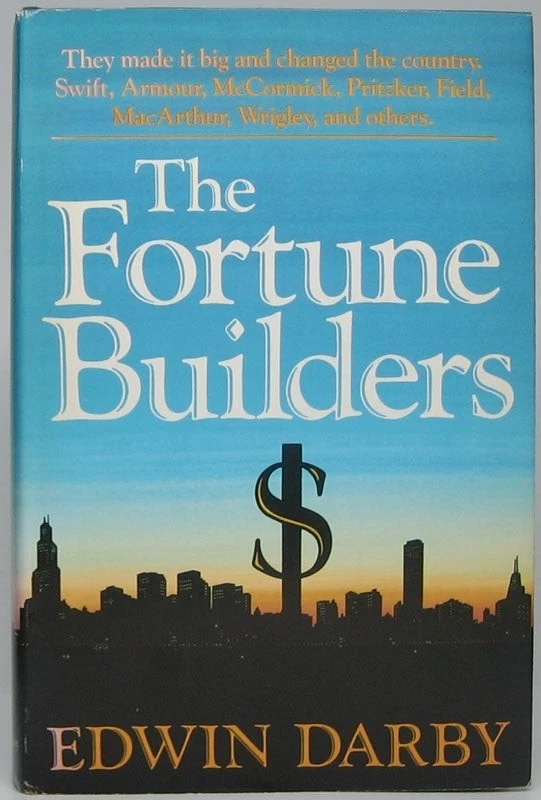
1986
Biography
by
Edwin Darby
1986